
Online Oceans
I visited Southampton’s National Oceanography Centre (NOC) in April for the product launch of Online Oceans’ Scout Unmanned Surface Vehicle (USV).
The company’s Co-founder and CEO George Morton talked through the vessel’s features, his cutting-edge USV dwarfed by NOC’s near 100-metre long research vessel RRS Discovery that had just tied on at the dock:
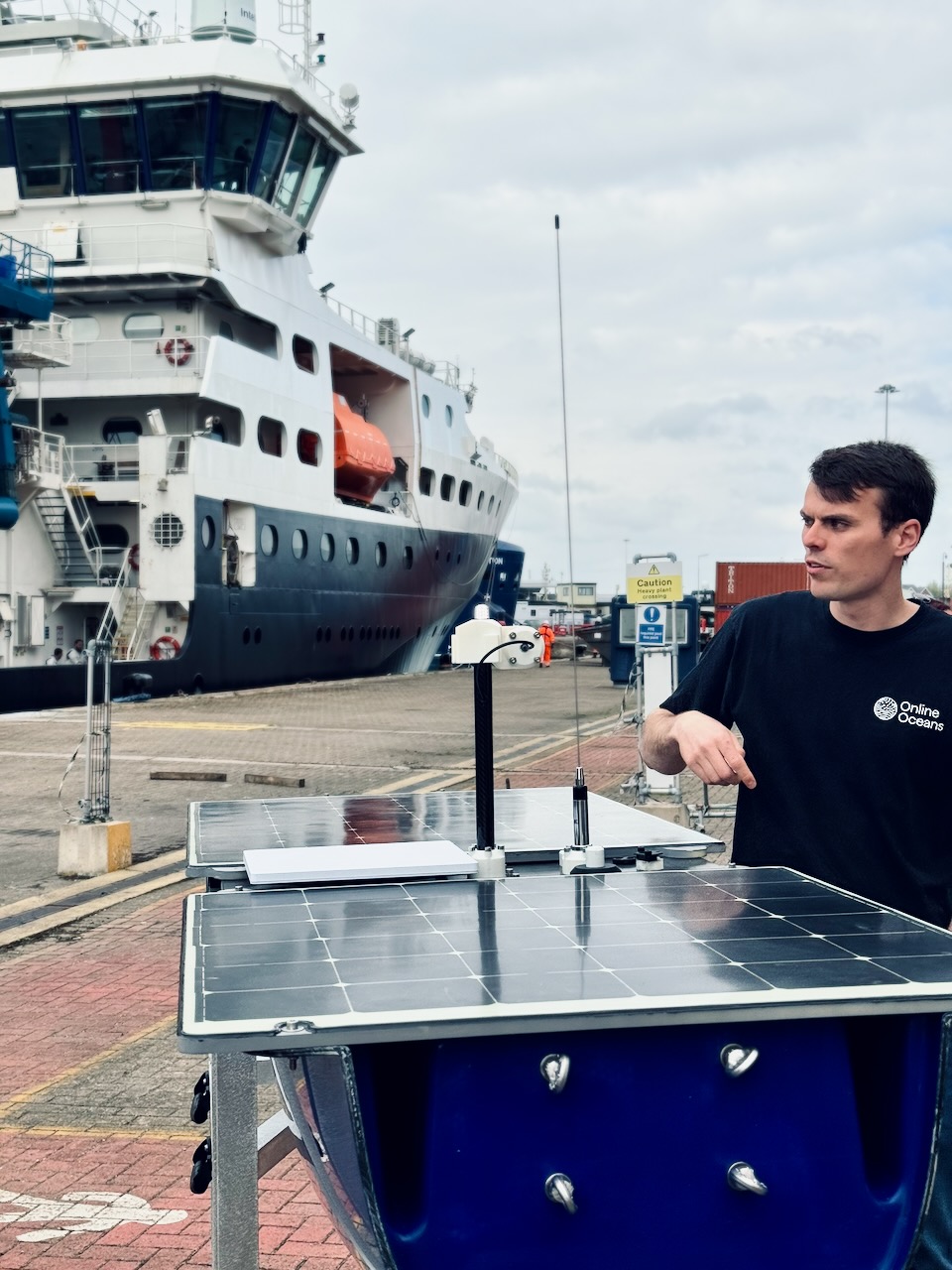
Online Oceans’ Scout USV Launch Event | Co-founder & CEO George Morton at the National Oceanography Centre, Southampton | April 2026.
Morton’s pedigree incudes nearly seven years at ExxonMobil and an 18-month stint at US marine robotics business Ocean Infinity in Texas. The British startup he now helms announced a £4m injection of funding just after the event, with some notable investors on the cap table.
Led by SpaceTech VC Seraphim (whose Maureen Haverty takes a board seat) other round participants caught our eye:
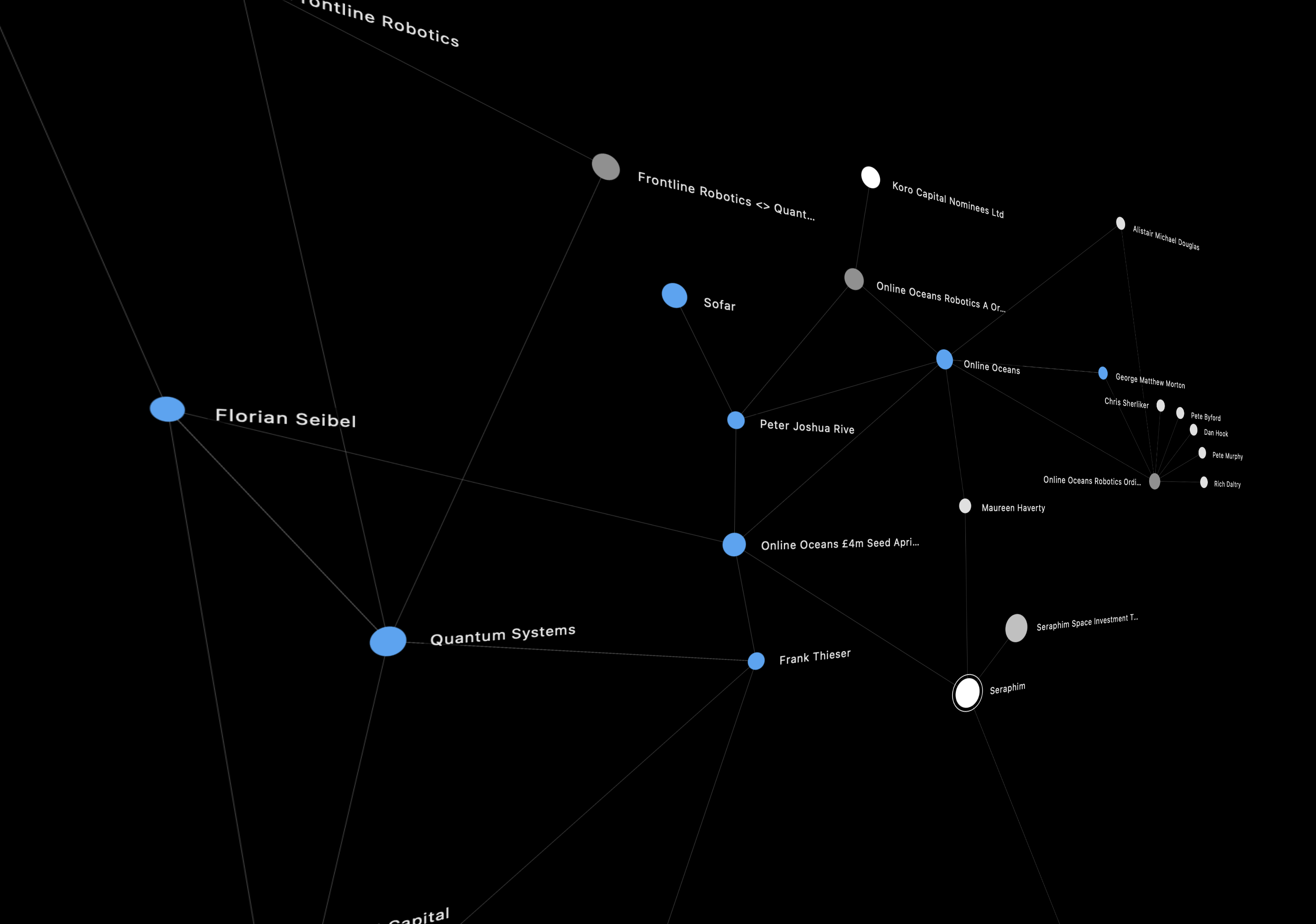
A snapshot of market structure data captured from our Cloud Empire™ knowledge graph platform, highlighting some of the participants in Online Oceans’ £4m Series A funding round.
SolarCity Co-founder, Chairman of US maritime intelligence company Sofar (and cousin to the world’s richest man - Elon Musk) Peter Rive participated in the round too. It suggests a lot more to come from the two companies, following a recently announced collaboration on the ‘Sofar Ocean Spotter Scout’ which sees Sofar’s sensor payload (hitherto buoy based) deployed on Scout USVs. Details in this video.
Also notable are two German angels emerging as key nodes in the ‘Munich Defence Tech Mafia’ network; Florian Seibel (Quantum Systems Co-founder and co-CEO) and Frank Thieser (also of Quantum Systems) - both very active investors in European Defence Tech startups, or as Thieser puts it in his own words “working on European tech sovereignty”. As Quantum Systems expand from Unmanned Aerial Vehicles (UAVs) to Unmanned Ground Vehicles (UGVs) (see this February announcement), it’s easy to see how Online Oceans might help form the third pillar of their autonomous vehicle empire; encompassing Air, Land & (soon) Sea.
Scout and Tether
The 2.5m long Scout USV features a ‘flooded-hull’ design and is electrically propelled by a custom-designed 2kWh li-ion battery pack, mounted in the keel for stability and to moderate battery temperature. Designed for 3-6 month deployments it can be launched from shore, transported in a standard wheelbase van and uses Iridium for telemetry plus Starlink for realtime acoustic / photographic / video data streaming.
There’s up to 200 watts available for payload power, isolated from control power to reduce electromagnetic interference. Towed array sensor deployments of various types have already been conducted. Trials have seen the little boats operate in up to 40-50 knot winds, though Morton suggests station-keeping in winds above 35 knots becomes a challenge. Here’s a closeup view of the vehicle’s ‘bridge’:
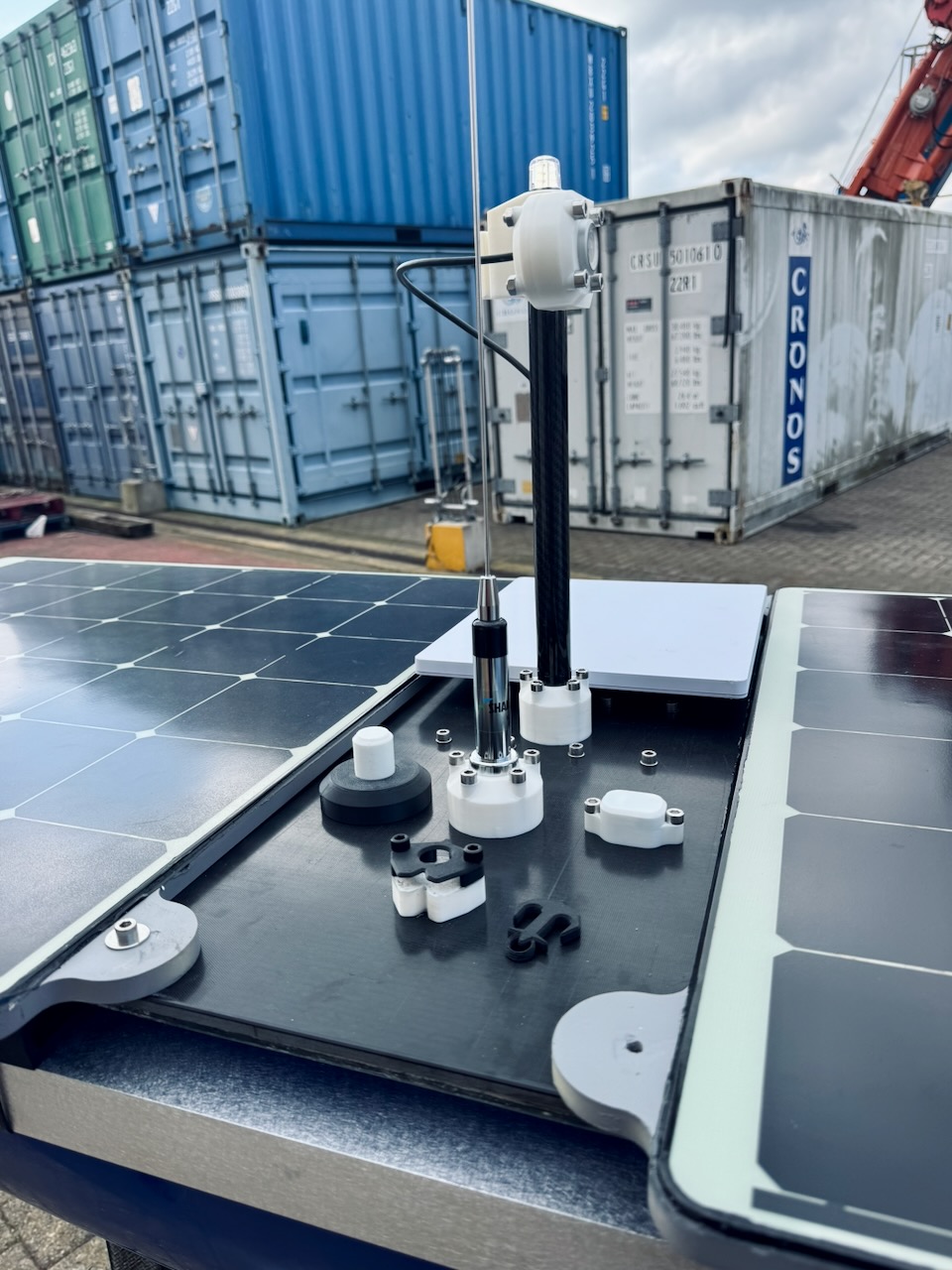
‘The Bridge’ of Online Ocean’s Scout USV, featuring light, satcomms antennae, ruggedised camera enclosure and Starlink Mini terminal.
Currently priced from c. £19k GBP, excluding sensors (often costing more than the vessel itself) but including aluminium launch trolley which enables the craft to be easily launched from any boat ramp or suitable beachfront. Doesn’t include £100 / month subscription to the company’s geospatial control platform ‘Tether’, (required). From it Scout USVs can be piloted, controlled, data and fleets managed. Iridium and Starlink subscription costs are also additional (Starlink maritime c. £250/month at time of writing).
Waypoint missions can be set - with drift control accounting for tide and weather. Loiter locations can also be set with a ‘virtual anchor’. Live vehicle control is also possible. Alarms can be set (eg. via simple WebHooks or email) for alerting users of off-target vehicles too. AIS data is received for deconfliction.
A solar power planner is also included to help determine where a vehicle can operate with a given payload, in a specified location and at different times of year. Load shedding schedules can also be set to aid in on-board vehicle power management.
From the Advanced Research + Invention Agency (ARIA) to the British Royal Navy the company already has a growing (and impressive) network of customers and partners.
Cambridge Aerospace
From the Sea domain into the Sky next, we’ve also been looking into British counter Unmanned Aerial System (cUAS) startup Cambridge Aerospace, a company (pun wholeheartedly intended) that has been flying low and under the radar since its founding in 2024 by CEO and MIT alumnus Steven Barrett.

You’ll find relatively little online about the stealthy British air defence startup.
The company just announced units of their ‘Skyhammer’ (reportedly) tube-launched air defence system (30km range, 700 km/h top speed) will be delivered to the UK Ministry of Defence this month, following reports in March in the Financial Times that recent funding had already seen the British business top a $1bn 🦄 valuation.
Looking at the company’s cap table in Cloud Empire™ it’s striking how much international capital the company has attracted - more than 30 entities based outside of the UK have poured cash into the startup, with funds raised reportedly at $136m as of late 2025:
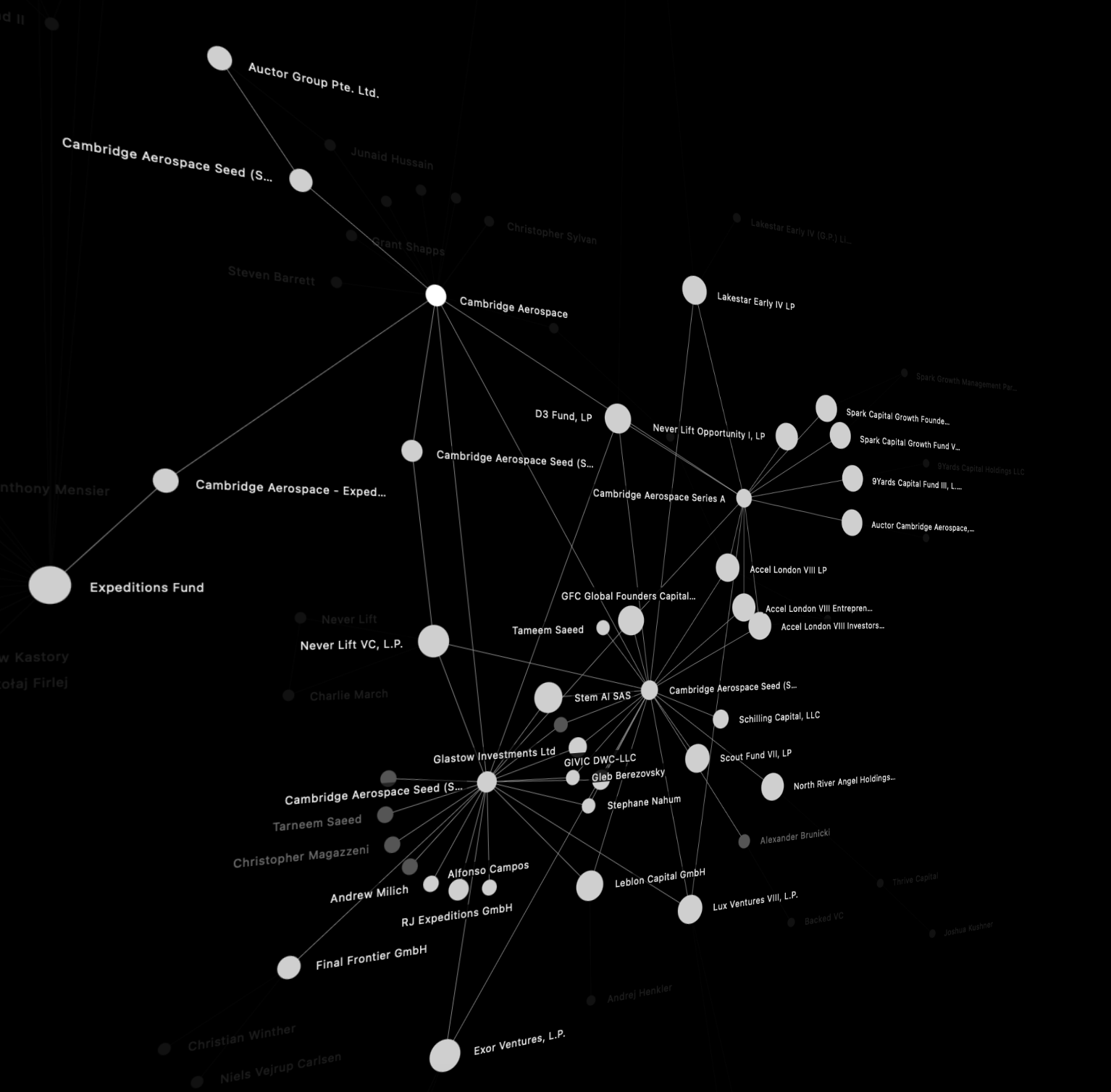
The complex network of international investment vehicles behind Cambridge Aerospace, those in white are domiciled outside of the UK, those in grey are domestic.
Notable holders of equity across five separate funding rounds (inferred from four separate classes of seed funding equity + a more traditional Series A) include:
- Palo Alto based Accel (famous for their 10% stake in Facebook, pre-revenue, worth $6.6bn at IPO seven years later) via multiple entities of their ‘VIII’ vintage fund vehicles - Harry Nelis takes a board seat
- Ukrainian defence tech VC D3 - via a Cayman Islands LP
- The Italian Agnelli family (known for establishing Fiat and owning Alfa Romeo, Ferrari, Lancia and Stellantis) via their Exor Ventures arm
- Polish defence tech specialist VC firm Expeditions Fund (we believe via a third party on their behalf, possibly Lux though unconfirmed)
- Danish space and defence micro-fund Final Frontier via a German GmbH vehicle
- The Samwer Brothers’ Rocket Internet global venture capital platform Global Founders Capital (GFC) operating out of Berlin
- German investor Klaus Hommels’ Lakestar (he also takes a board seat) via the firm’s ‘Early IV’ vintage Guernsey fund
- Josh Wolfe’s Lux Ventures - early backers of Anduril, Databricks and HuggingFace🤗 - via their $1.15bn Lux 8 fund - Partner Tess Van Steklenburg takes a board seat
- Never Lift - an early stage VC operated out of New York by GP Charlie March whose family own the renowned Goodwood Estate - they doubled down with a single investor tranche at one point and are reported to have “participated in every round of funding to date”
- Spark Capital - another US fund, early backers of Twitter, with a reported $15bn in AUM
Europe’s AI Renaissance?
Next into the Cloud Empire™ Knowledge Graph will be some monster rounds for European AI startups. In Volume II we’ll take a look at who - besides the British government’s Sovereign AI fund - is behind the staggering $1.1bn ploughed into the newly incorporated Ineffable Intelligence, founded by David Silver - former Reinforcement Learning (RL) lead at DeepMind.

“A note from Dave” on the company’s website sets out Silver’s intentions with the startup.
Ineffable’s monster raise came hot on the heels of Advanced Machine Intelligence (AMI) / AMI Labs, founded just the other side of La Manche by Yann LeCun - perhaps best known in industry for serving as Chief AI Scientist at Meta until recently (though that’s just the latest chapter in a noteworthy career in Artificial Intelligence (AI) / Machine Learning (ML) that started out at Bell Labs in New Jersey back in the 1980s).
We’ll be mapping the enormous $1.03bn round they raised from backers including Eric Schmidt, NVIDIA, Temasek and Toyota, to name but a few of their backers.

“Advanced Machine Intelligence (AMI) is building a new breed of AI systems that understand the world, have persistent memory, can reason and plan, and are controllable and safe.”
A deep dive into the renaissance of European AI to follow!


